I Was Quoted in an Article about Editing

I was quoted in a blog post from the Editors Tea Club called “Who Are the Editors, In Their Own Words.” I was one of about two dozen members of the Editors Tea Club whose responses informed this blog post, so there’s only one quote from me, but the whole article is an interesting look at freelance editing as a profession. You can read the blog post here.

If you’re curious about my editing services, you can go to the editing page of this very website. Here’s the short version: I do copy editing, proofreading, and sensitivity reading, meaning that I mostly work with punctuation, grammar, and other nitty-gritty aspects of written works, not big-picture story components like plot and pacing. The exception is sensitivity reading, where I read and edit with specific attention on the way you’ve written character(s) with a marginalized identity I share, which can involve taking more of a big-picture view of the character’s arc.

Find out more about the services I offer on my editing page and get in touch via my contact form if you’d like to work together.

I Was Quoted in an Article about Self-Publishing

I was interviewed for this article about the modern self-publishing landscape and how it interacts with the state of the publishing industry writ large. It’s a thorough, insightful piece of journalism that does in fact quote me, and you can read it for free with this gift link. Here’s the part about me:

When author Linnea Peterson looked at the contract they turned down from a traditional publisher for their book, The Girls Will Be Okay, they realized that “this will give the vast majority of the financial control and creative control over the future of the story to people who are not offering me much in return in terms of editing or marketing.” That experience helped Peterson “believe in myself and the story” and to “consider self-publishing” so they could tell the story they wanted to tell.

How to Request the Ebook of The Girls Will Be Okay from Your Library

Like most authors, I’d really like it if you bought my book. My debut novel, The Girls Will Be Okay, is a nerdy, interfaith queer young adult romance about a Lutheran girl coming to terms with her bisexuality and her crush on her lesbian Jewish best friend by writing fanfiction about their favorite detective show, and you can buy it here. I’d like it if you did buy it! I think it’s a good book that’s worth buying!

But I also know that inflation is high, money is tight, and many of us have neither the funds nor the shelf space to buy every book we’d like to read. That’s real. So if you want to read my book without buying it (and without pirating it, which is a disrespectful thing to do with books and can tangibly harm authors’ careers), or even if you’ve already bought my book but want to support it in other ways, here are some instructions for requesting a digital copy of my book from your library.

While it’s outside the scope of this post, you can also request that your library purchase a physical copy of my book. The self-publishing platform I use (IngramSpark) distributes books through the system that libraries use for acquisitions (Ingram), so it should be straightforward for the library to get either a physical or a digital copy or both. The reason I’m not giving instructions for that is because there’s a lot more variation in processes for requesting that your library buy a physical book, whereas most libraries use the same ebook app, which makes the process pretty much the same anywhere.

For this process, you’ll want to use a smartphone, and I’m including lots of screenshots to hopefully make the instructions super clear.

Part 1: Download the Libby App

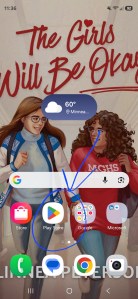
Go to the App Store or Google Play Store (your phone will have one or the other).

A screenshot of the home screen of a smartphone. The Google Play Store app is circled, and there is an arrow pointing to it.

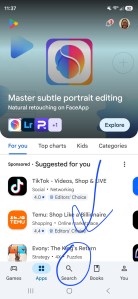
In the search bar, type “Libby.”

A screenshot of a smartphone screen open to the Google Play Store. The search button at the bottom is circled, and there is an arrow pointing to it.

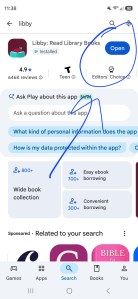
You should find an app called Libby, the Library App, made by Overdrive, Inc. Download the app. (I already have the app, so it says “Open” where it will say “Download” if you don’t have the app yet.)

A screenshot of a smartphone screen displaying the Libby app within the Google Play Store. The app has already been installed, so there is a button that says "Open," which is circled and has an arrow pointing to it.

Part 2: Connect Your Card

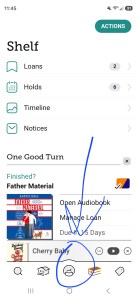
The Libby app has five icons at the bottom of its display screen. Click the middle one.

A screenshot of a smartphone screen open to the Libby app. The middle icon toward the bottom is circled and has an arrow pointing to it.

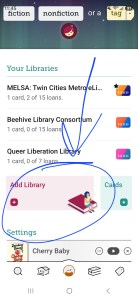
This should bring you to a page with an option that says Add Library (you may need to scroll down). Click on it.

A screenshot of a smartphone screen open to the Libby app. There is a pink box that says "Add Library," which is circled and has an arrow pointing to it.

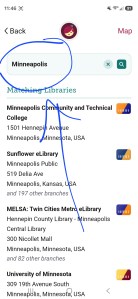
You can search for your library by using the map or searching by the library’s name, city, or zip code.

A screenshot of a smartphone screen open to the Libby app. There is a search bar across the top, and the word "Minneapolis" has been entered into the search bar, which is circled and has an arrow pointing to it. The rest of the screen shows results for libraries in Minneapolis that use Libby.

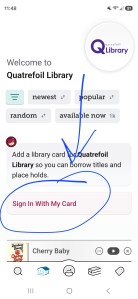
Once you have found your library, you will need to enter your library card information.

A screenshot of a smartphone screen open to the Libby app's page for the Quatrefoil Library. There is a pink rectangle that says "Sign In With My Card," which is circled and has an arrow pointing to it.

Part 3: Find The Girls Will Be Okay by Linnea Peterson

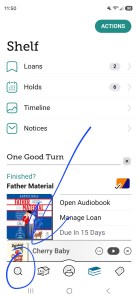
Go to the left-most icon at the bottom of the Libby screen. This will bring you to the search page.

A screenshot of a smartphone screen open to the Libby app. The left-most icon toward the bottom is circled and has an arrow pointing to it.

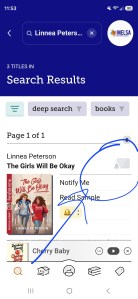
In the search bar, type “Linnea Peterson.” (Searching The Girls Will Be Okay brings up a bunch of other books with similar titles and may not bring up my book if your library doesn’t have it yet.) The first result should be the ebook of The Girls Will Be Okay.

Part 4: Request The Girls Will Be Okay by Linnea Peterson

Next to the title of the book, there should be a light gray rectangle with a yellow bell icon in the lower left corner of the rectangle. Click on it. (This looks a little different on my screen because I’ve already done it, but you should click on the place I circled.)

A screenshot of a smartphone screen open to the Libby app, showing search results for Linnea Peterson. The first result is The Girls Will Be Okay. There is a small light gray rectangle next to the title. The light gray rectangle has been circled, and there is an arrow pointing to it.

You will see a message that says, “This title is not in your library’s catalog. Tag it to receive a notification if the library acquires copies.” Below that message, there should be a bell icon again. Click the bell icon.

You have now requested the ebook, and you’ll be notified if your library buys it!

My short story “Sonic Boom of My Heart” is available for purchase

My queer superhero romance short story “Sonic Boom of My Heart” is available for sale via the Duck Prints Press Patreon shop. It’s about 6,700 words long, and it follows a superhero with sound powers who escapes an abusive relationship and winds up on the doorstep of his nemesis, a not-particularly-evil supervillain with time manipulation powers. It’s about realizing that sometimes the people who claim to love you are actually hurting you, and sometimes the person you think is your enemy actually understands and cares about you more than either of you thought possible. You can buy it as a digital download for $3.00 here.

Extraterrestrials: Another Autistic Trans Anthology is out now!

I’ve got a short story in an anthology that came out yesterday! It’s called Extraterrestrials: Another Autistic Trans Anthology, and it includes a bunch of different short stories about and for teenagers, centering characters who are both autistic and transgender/nonbinary, written by authors who live at the intersection of autistic and trans identities.

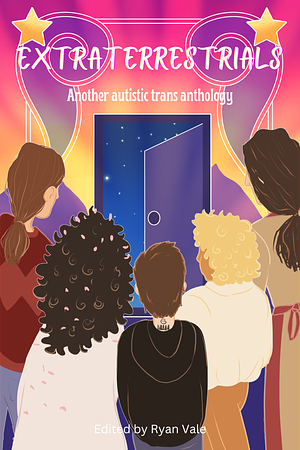
The cover of Extraterrestrials: Another Autistic Trans Anthology, edited by Ryan Vale.

My story, “Clothes That Fit,” is a prequel to an unpublished novel of mine. The main character of the novel has been out as nonbinary for a few months when the book starts, so I figured it would be fun to write a short story about their experience coming out to their friends. It’s a low-stakes feel-good story about supportive friendships and the joy and relief of shopping for clothes you actually want for the first time.

You can order the paperback or ebook here.

I Have a Story in Extraterrestrials: Another Autistic Trans Anthology

I know I just published a book two months ago, but I’ve got a different writing project to announce! I’m part of an anthology that’s coming out in ten days. It’s called Extraterrestrials: Another Autistic Trans Anthology, and it includes a bunch of different short stories about and for teenagers, centering characters who are both autistic and transgender/nonbinary, written by authors who live at the intersection of autistic and trans identities.

The cover of Extraterrestrials: Another Autistic Trans Anthology, edited by Ryan Vale. The cover shows five people facing away from the viewer, toward a door, which is opening into the starry night sky.

My story, “Clothes That Fit,” is a prequel to an unpublished novel of mine. The main character of the novel has been out as nonbinary for a few months when the book starts, so I figured it would be fun to write a short story about their experience coming out to their friends. It’s a low-stakes feel-good story about supportive friendships and the joy and relief of shopping for clothes you actually want for the first time.

The ebook is up for preorder. I’m not sure if there’s going to be a paperback, so if you only do physical books, maybe check back on the release date, August 27. But if you like ebooks, you can get it now for just $4.99 + tax!

4 Books for Queer Christian Youth and Young Adults

We’re in an era of rising Christofascism, where mainstream news outlets are interviewing self-described Christian nationalists who want to overturn the Supreme Court decision that legalized same-sex marriage across the US and the government is outlawing trans health care, bathroom use, and sports opportunities in a cynical bid to keep the support of Evangelicals by convincing them that being anti-gay and anti-trans is more truly Christian than supporting immigrants and health care access. It can feel like being queer and Christian at the same time is a contradiction, a paradox, an impossibility, and I think that sense of tension takes a particular form for teens and young adults today, who have grown up in a world where same-sex marriage is legal in the US, the existence of trans people is common knowledge, queer visibility is at an all-time high, and the backlash to that reality is also at a fever pitch. 

While I’m no longer Christian, I was an out queer Christian for almost a decade, and the reasons I left Christianity aren’t about my queerness; they’re about the difficulty I had finding balance in life while worshiping a martyr and having a personality that tends to take things to extremes. I had the good fortune to spend almost my entire Christian life in Reconciling in Christ congregations, and over the years, I had three wonderful out gay men as pastors, each of whom had a husband. And although I’ve left the church, I still care deeply about progressive Christian communities, and I want to help queer young people in those Christian communities have the best experience possible—to not just be accepted, but to be affirmed and anticipated. 

Part of properly anticipating your congregation’s queer youth is making sure that the adults in the congregation already know enough about queerness to use their pronouns, understand their identity labels, and avoid asking invasive questions. If you or other adults in your congregation need more information in order to do that well, I highly recommend the book Welcoming and Affirming: A Guide to Supporting and Working with LGBTQ+ Christian Youth, edited by Leigh Finke. But another part of anticipating your queer youth is giving them books, resources, and opportunities that let them be themselves and see themselves reflected in their faith community. Here are four books I recommend keeping in your church library or youth room, or having in the youth director’s office to be lent to youth who might be interested. 

Queerfully and Wonderfully Made: A Guide for LGBTQ+ Christian Teens

Queerfully and Wonderfully Made is a companion to Welcoming and Affirming and is also edited by Leigh Finke. While Welcoming and Affirming addresses adults’ questions about how to interact with queer youth in their church, Queerfully and Wonderfully Made answers queer Christian teenagers’ questions about their sexual orientation, gender, and faith in an affirming manner, reminding teens over and over that God loves them as they are and does not need them to become less queer in order to be acceptable. The book is written specifically for teenagers and is formatted as a Q&A, so it’s very practical and doesn’t require wading through long chapters or even reading the whole thing in order. It’s a good starting point for queer Christian teens, particularly for those who might be struggling with the impact of religious homophobia and/or transphobia. 

The Girls Will Be Okay

The Girls Will Be Okay is the only fiction book on this list, and, as its author, I’m obviously biased. But here’s my pitch: the protagonist, Solveig, is a Lutheran girl who realizes over the course of the book that she’s bisexual and has feelings for her lesbian Jewish best friend, Sarah. Both Solveig’s and Sarah’s faith practices are important to them; multiple scenes take place during church services, and most of a chapter is devoted to the Passover Seder that Sarah invites Solveig to attend. It’s rare for young adult novels to feature protagonists who take their religion seriously, and it’s even more rare when the protagonists are queer and their faith communities are supportive and affirming. I made these choices while writing the book because, as a teenager, I couldn’t find any books or movies featuring progressive, deeply religious characters in modern-day settings, let alone characters embracing both their queerness and their faith the way I was. I hope that other queer religious teenagers can read The Girls Will Be Okay and resonate with the characters’ confidence that their queerness is not a threat to their religiosity and vice versa. 

Still Stace: My Gay Christian Coming-of-Age Story, An Illustrated Memoir

Still Stace by Stacey Chomiak is a graphic memoir, meaning it’s a full-length book telling the story of the author’s teenage and young-adult years via comic-book-style illustrations and dialogue. Unlike the main characters of The Girls Will Be Okay, Stacey Chomiak did not have the benefit of an affirming religious community, and for a while she tried to become ex-gay because she was convinced that being gay was a bad thing and that she couldn’t be both gay and Christian. This book definitely delves into heavy topics, but it ends with Stacey learning to love her full self and reconciling her sexuality with her faith. To teens from extremely supportive families and churches, Still Stace might feel dated, but for youth who are facing homophobia or transphobia from close family or from current or former pastors and other faith leaders, this book might be exactly what they need to make sense of their situation. 

Kissing in the Chapel, Praying in the Frat House: Wrestling with Faith and College

I’ll be honest: Kissing in the Chapel, Praying in the Frat House is over a decade old, and a lot of it will likely feel dated to the people currently in church youth groups. Part of the reason I’m including it is because it came out during my first year of college; I found it in my campus mailbox one day—a gift from one of my theologian mother’s seminary-trained cousins—and it wound up speaking to me in ways that I needed at 18. Despite its 2014 publication date, I think this anthology of essays by folks in their 20s and 30s reflecting on the way that college affected their faith will also speak to some college-bound young folks today. For one thing, the essays come to a whole bunch of different conclusions about faith; one essay is called “After Prayerful Consideration: Becoming a Religious Atheist,” while another is titled “Out of the Closet and Back to Church.” Also, this book was one of the first places I encountered the idea of nonbinary gender identities, and I was very glad to read a first-person essay about a nonbinary person viewing their experience with gender as good and holy. The book as a whole isn’t about queerness, and any Christian student heading off to college might benefit from reading, but enough of it is explicitly about the experiences of queer people wrestling with faith in college that I think it fits well on this list. 

Conclusion

While having a church welcome statement that includes sexual orientation and gender identity is a good start when it comes to welcoming queer folks at your church, making queer members and visitors of all ages feel truly welcome is a much larger task. No one book—or even four or five books—is going to make up for the sense of othering that queer teens feel when fellow church members don’t use their pronouns or treat their clothing or dating lives as appropriate topics for question after question. But books like Welcoming and Affirming can help adults in church settings figure out how to understand and interact with queer youth in their congregations, and having the other books on this list on hand can signal to queer teens in your church that you knew you’d have queer youth in your youth programming. 

It’s very othering to have people act surprised that you exist (“What? A queer teenager in our youth group?! Well, I’ll figure it out, but I never thought we’d have to deal with this!”). And on the flip side, when people are already prepared for you before you arrive or come out (not “I’m pretty sure so-and-so is gay,” but “It stands to reason that we’ll have at least a few queer kids in our church, if not now then in the next few years”), that can be a huge relief. So if you’re not already prepared for your youth group to include queer teenagers, now is the time to train your staff and volunteers to be respectful and competent when interacting with queer teens, and also to make sure you’re got materials (such as the books on this list) at your church and available for kids seeking guidance on reconciling their queerness with their faith, or looking for stories where faithful queer young folks are represented.
Use The Girls Will Be Okay in Your Book Club with These Discussion Guides

Particularly because of its approach to religion and intergenerational family life, The Girls Will Be Okay lends itself to deep, enriching group discussion. I’ve written discussion guides for four different types of groups: secular teen book clubs/class discussions, church youth groups, synagogue youth groups, and groups where parents and teens discuss the book together. You can find the discussion guides here.

Praise for The Girls Will Be Okay from Twin Cities Geek

I was overjoyed to see an extremely positive review of The Girls Will Be Okay in Twin Cities Geek, a volunteer-run journalism outlet covering local geek culture where I used to edit and occasionally write articles. The reviewer, Stephanie Cranford, clearly understood what I was trying to do in the book. Here’s my favorite paragraph:

“It can feel uncommon for characters to be both religious and liberal, but Peterson has written two leads who are. Solveig’s mother used to be the pastor of their (liberal) Lutheran church, and she was the one who led it to becoming queer-affirming almost two decades before the time the book is set. Solveig herself sings in the children’s choir and helps teach Sunday School, in addition to singing her heart out in church services. Sarah is observant as well, teaching Hebrew school and singing in her synagogue’s children’s choir. Later in the book, she invites Solveig to a seder. Their religious beliefs and their queer identities never come up as a point of conflict, nor should they have to. As someone who was raised ELCA (liberal) Lutheran, I found it refreshing to see religious characters who were like the people in my family.”

Check out the full review here!