My queer superhero romance short story “Sonic Boom of My Heart” is available for sale via the Duck Prints Press Patreon shop. It’s about 6,700 words long, and it follows a superhero with sound powers who escapes an abusive relationship and winds up on the doorstep of his nemesis, a not-particularly-evil supervillain with time manipulation powers. It’s about realizing that sometimes the people who claim to love you are actually hurting you, and sometimes the person you think is your enemy actually understands and cares about you more than either of you thought possible. You can buy it as a digital download for $3.00 here.
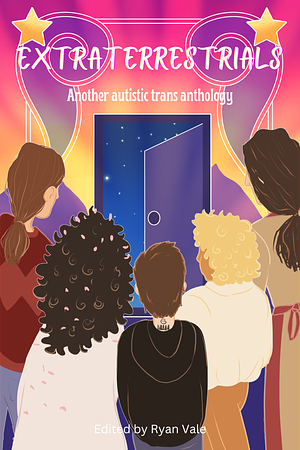
Extraterrestrials: Another Autistic Trans Anthology is out now!
I’ve got a short story in an anthology that came out yesterday! It’s called Extraterrestrials: Another Autistic Trans Anthology, and it includes a bunch of different short stories about and for teenagers, centering characters who are both autistic and transgender/nonbinary, written by authors who live at the intersection of autistic and trans identities.
My story, “Clothes That Fit,” is a prequel to an unpublished novel of mine. The main character of the novel has been out as nonbinary for a few months when the book starts, so I figured it would be fun to write a short story about their experience coming out to their friends. It’s a low-stakes feel-good story about supportive friendships and the joy and relief of shopping for clothes you actually want for the first time.
I Have a Story in Extraterrestrials: Another Autistic Trans Anthology
I know I just published a book two months ago, but I’ve got a different writing project to announce! I’m part of an anthology that’s coming out in ten days. It’s called Extraterrestrials: Another Autistic Trans Anthology, and it includes a bunch of different short stories about and for teenagers, centering characters who are both autistic and transgender/nonbinary, written by authors who live at the intersection of autistic and trans identities.
My story, “Clothes That Fit,” is a prequel to an unpublished novel of mine. The main character of the novel has been out as nonbinary for a few months when the book starts, so I figured it would be fun to write a short story about their experience coming out to their friends. It’s a low-stakes feel-good story about supportive friendships and the joy and relief of shopping for clothes you actually want for the first time.
The ebook is up for preorder. I’m not sure if there’s going to be a paperback, so if you only do physical books, maybe check back on the release date, August 27. But if you like ebooks, you can get it now for just $4.99 + tax!
Praise for The Girls Will Be Okay from the St. Paul Pioneer Press
My debut novel, The Girls Will Be Okay, comes out next week, and I was pleased to hear that it was reviewed in the St. Paul Pioneer Press! As a Twin Cities-based author who grew up in St. Paul, it means a lot to me to be reviewed in my hometown paper. And it seems like the reviewer liked my book! You can check out the review here.
Quote: “One of the best things about this story is how smart these girls are. But they are smart in different ways and that comes out in an emotional fight that teaches the three friends a lot about themselves.”
Get My Short Story (and Many Others) While Supporting Queer Nonprofits
Duck Prints Press, the publisher that put together the queer Pride and Prejudice-inspired anthology I had a story in last year, is selling digital bundles of short stories and art this Pride month, with most of the revenue going to queer nonprofits. My queer superhero romance, “Sonic Boom of My Heart,” is in the general imprint bundle, which is a collection of 25 queer short stories that don’t have sex on the page. There’s also an explicit bundle containing 15 stories that do have sex on the page, as well as an art bundle full of visual art. The Press is donating its portion of the proceeds from these bundles to the Queer Liberation Library, a digital library of queer e-books and audiobooks that’s freely accessible to anyone in the US, and the Transgender Law Center. If you like queer short stories, check them out!
My Short Story “Gradual” Was Published in The Metaworker
My lyrical fantasy short story, “Gradual,” was published in a literary magazine called The Metaworker. “Gradual” is a piece of flash fiction, meaning it’s under 1,000 words. It tells an expansive story in few words; it’s about the transformative power of creativity, and it’s eerie and weird but still beautiful. Read it here.
Why I Wrote a Deeply Norwegian American Protagonist Instead of a Culturally Generic White One
As someone who grew up in a deeply Scandinavian American family—attending weekly language classes at the American Swedish Institute, spending weeks each summer at a Swedish-immersion summer camp, living in a home decorated with Norwegian handicrafts like rosemaling and hardanger that my great-grandparents had made—I remember feeling as a teenager that a lot of YA protagonists I was reading weren’t like me.
Of course, part of this was because I’m autistic and queer, both of which are identities that are underrepresented in young adult literature and were even less written about in the early 2010s when I was in high school. But part of this feeling was also caused by the fact that most YA protagonists I encountered, especially in contemporary settings, were pretty culturally generic white American teenagers without a lot of intentionally identifiable cultural traits.
To be clear, white American culture is a culture. Hamburgers, milkshakes, and delivery pizza aren’t neutral, default foods. But because white American culture is so dominant in the US, it can seem like a neutral default if you’re used to it. And I think this is why there are so many books with culturally generic white American protagonists—for writers who are white Americans, this can seem like the most obvious choice or even the only choice they consider, and for writers with other cultural backgrounds, they’re often told that characters who aren’t culturally generic white Americans are “less relatable,” both by readers and by editors.
This pressure to write culturally generic white American protagonists is part of white supremacy culture. And I think the clearest way for me to push back on that in my own writing, as a white author, is to write characters who are culturally specific, even when they’re white. Part of this is wanting to represent my own experiences as a Scandinavian American. But part of it is also to challenge the notion that white is “normal” and culturally unmarked.
I found this especially important while writing The Girls Will Be Okay, because the relationship at the heart of the book is an interracial and interfaith one. I didn’t want the love interest, Sarah, to be the only one eating unfamiliar foods or celebrating cultural holidays. Yes, Sarah has a Jewish mom and a Sri Lankan dad, and Hanukkah, Passover, rotti, and kottu come up in the book. But Solveig, the protagonist, has specific cultural practices as well, making lefse, attending church five times during Holy Week, and celebrating Syttende Mai.
Another reason I wanted to write a Scandinavian American character in my queer YA book right now is that I refuse to cede Nordic culture to the far right. Nordic imagery and symbolism is frequently used by neo-Nazi groups and other white supremacists, and ideas about the supposed superiority of Scandinavians and Scandinavian Americans abound. As a queer and disabled person, I recognize the urgency of acting in solidarity with people of color to combat white supremacy, which has it in for all of us. And I want to do that solidarity work as my whole self, Scandinavian heritage and all. The white supremacists can’t take away my right to be Scandinavian American and queer and disabled all at once.
Obviously, none of this is to say that culturally specific books by white authors are a substitute for books by authors of color. The fact that I’m writing a culturally specific book in no way negates the structural advantages I have as a white author. If you’re looking for YA books by authors of color, I highly recommend checking out Bethany C. Morrow, Claire Kann, Angie Thomas, Brandy Colbert, Natasha Díaz, Emery Lee, Ann Zhao, Aminah Mae Safi, Nandini Bajpai, Bethany Mangle, Jenny Han, Racquel Marie, Gabe Cole Novoa, and Benjamin Alire Sáenz, as a starting point. But I think there’s also plenty of room for white authors to go deeper into our own cultural experiences when thinking about writing multi-cultural fiction. And that’s what I intend to do.
My Book Is Available for Preorder
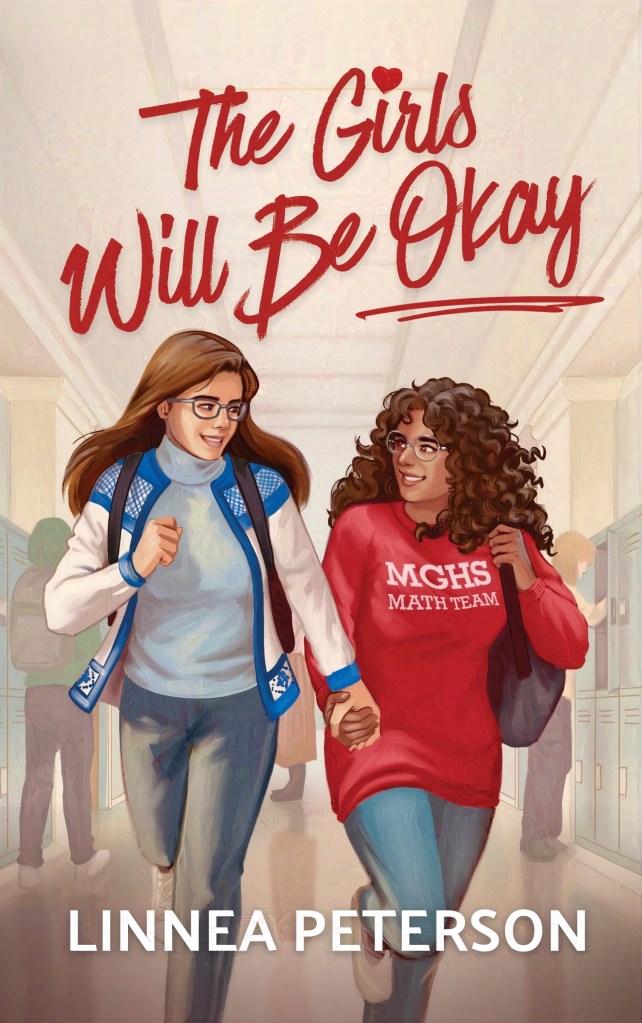
The Girls Will Be Okay is a nerdy, interfaith queer YA novel about a bisexual Lutheran girl coming to terms with her sexuality and her crush on her lesbian Jewish best friend by writing fanfiction about their favorite detective show.
Seventeen-year-old Solveig has life figured out. She’s mostly recovered from her mother’s death three years ago, she’s an excellent student, she loves her Lutheran church and family, and she’s a straight ally of the queer community-or so she thinks. She and her two best friends, Sarah and Heidi, are even in the same fandom for the first time in years. Senior spring is shaping up to be a wonderful last hurrah, never mind her tension with her middle sister, Berit.
But then Solveig realizes she has a crush on Sarah.
When Solveig’s obsession with and fear of her own feelings blow up both of her close friendships, her family-including Berit, who’s harboring a queer crush of her own-is the only place Solveig has left to turn. Can Solveig grow up enough to salvage her final semester of high school, or will she stay stuck in the rigid place she’s been since her mother died?
Preorder the paperback here or the ebook here!
Why preorder?
- So you won’t forget to order it later! Preordering now locks in your purchase, and you’ll get the book right when it comes out.
- Preorder sales count toward the first week’s sales in terms of book metrics. I’m not expecting to make any bestseller lists or anything, but having a strong first week of sales might help me be recommended within certain categories on bookshop.org (the site I’m linking to for preorders).
- Preordering helps tell the publisher and printer how many copies to print for the book’s initial print run. My book will be print-on-demand, which means there will generally be a lag between ordering the book and receiving it. If you preorder, you should get the book pretty close to the release date, which makes the date you’ll receive the book more predictable.
 Linnea Peterson